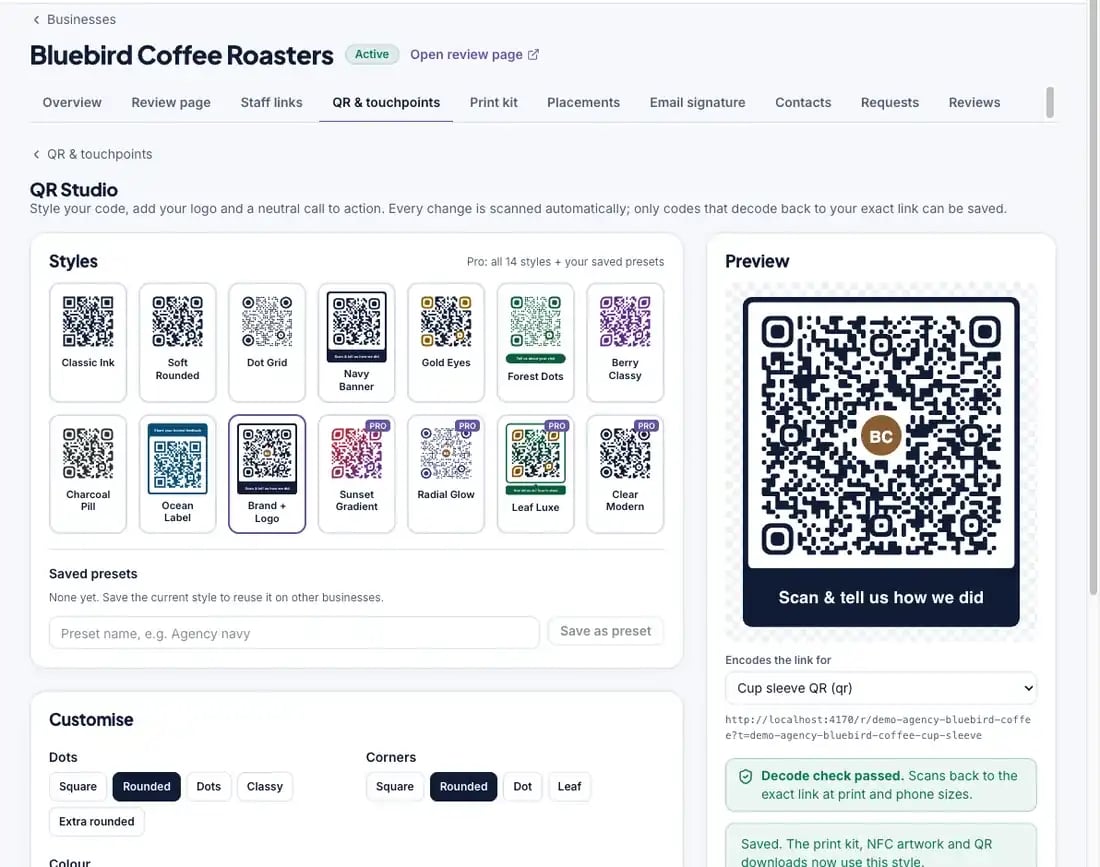

Our verdict and the evidence behind it
Tried & liked is the publisher’s verdict. The practical attraction is a connected workflow for a service that otherwise spans several tools. A business-specific review page, printable request materials, AI-assisted replies and a report can be easier to manage together.
That experience label is qualitative. The feature and offer descriptions below come from dated official materials, with seller screenshots identified as demonstrations. The publisher has not supplied measured review-growth data, a testing duration, a complete upgrade audit or client earnings to substantiate broader claims.
A sensible buyer starts with the work they need to deliver. If you already serve local businesses, compare the product’s request and reporting tools against your existing process. If you are starting an agency, also budget time for prospect research, permissions, sales conversations, configuration and ongoing support. Read the separate StarProfits AI pros and cons guide for the trade-offs.
What StarProfits AI actually does
The seller describes a local reputation workflow. Enter a business, inspect its listing and review gap, build a branded kit, ask real customers for feedback, prepare owner replies and show activity in a monthly report. Agencies can present that work under their own branding subject to the package and license they purchase.
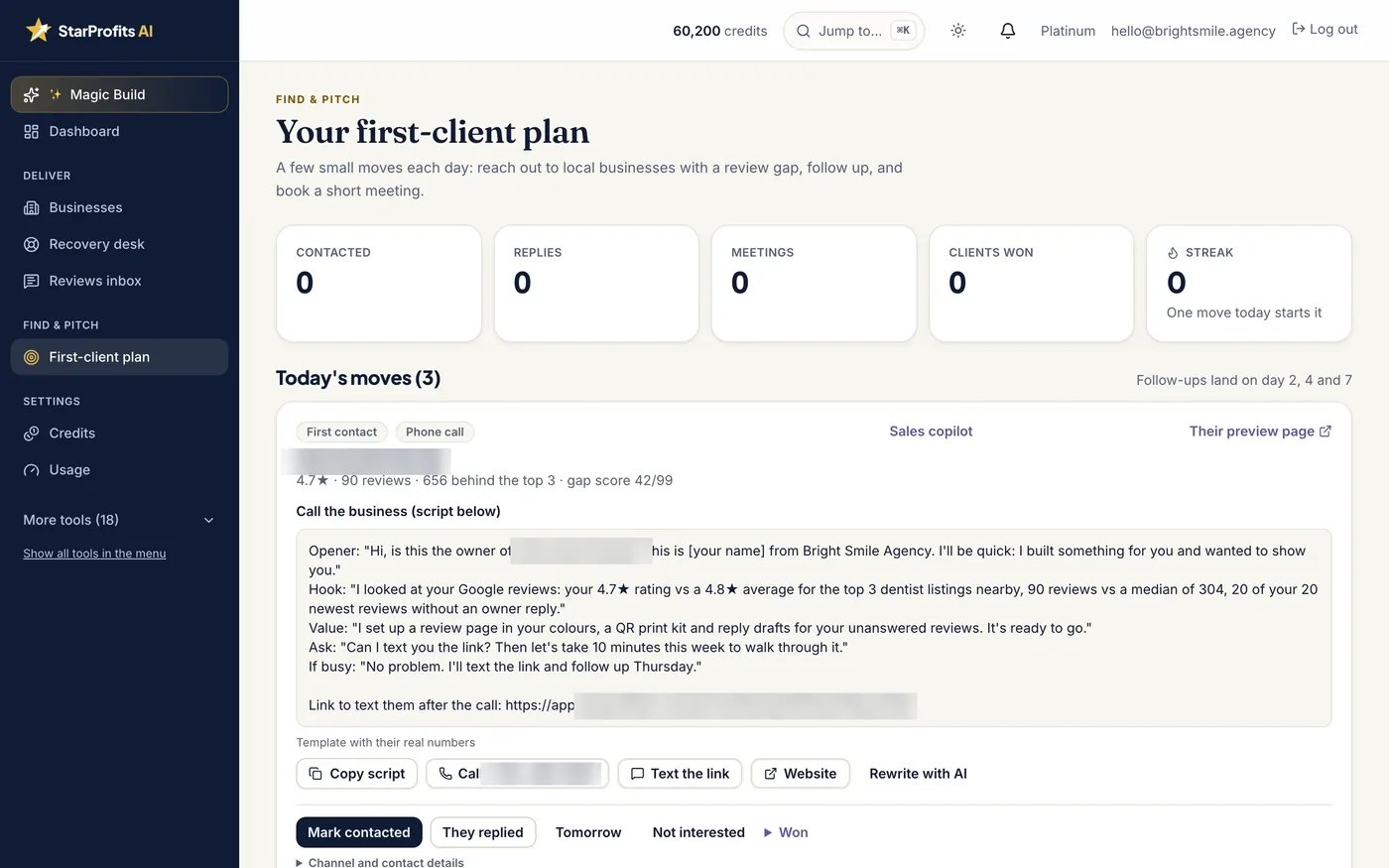
The useful distinction is between the business’s review process and the agency’s customer-acquisition process. A generated kit can make a proposal concrete. A proposal still needs an owner who agrees to buy, approves the setup and supplies an appropriate customer contact list. Software-generated materials do not establish a signed client.
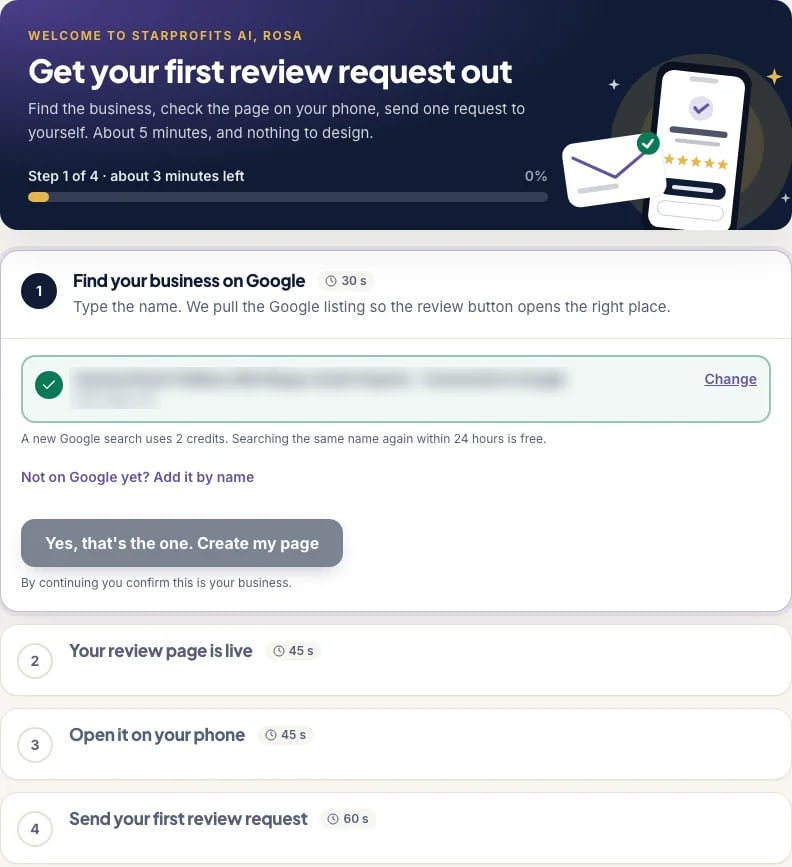
The workflow guide follows the complete sequence. The setup checklist separates the seller’s onboarding promise from the configuration decisions a business should review.
Magic Build turns a listing into a review kit
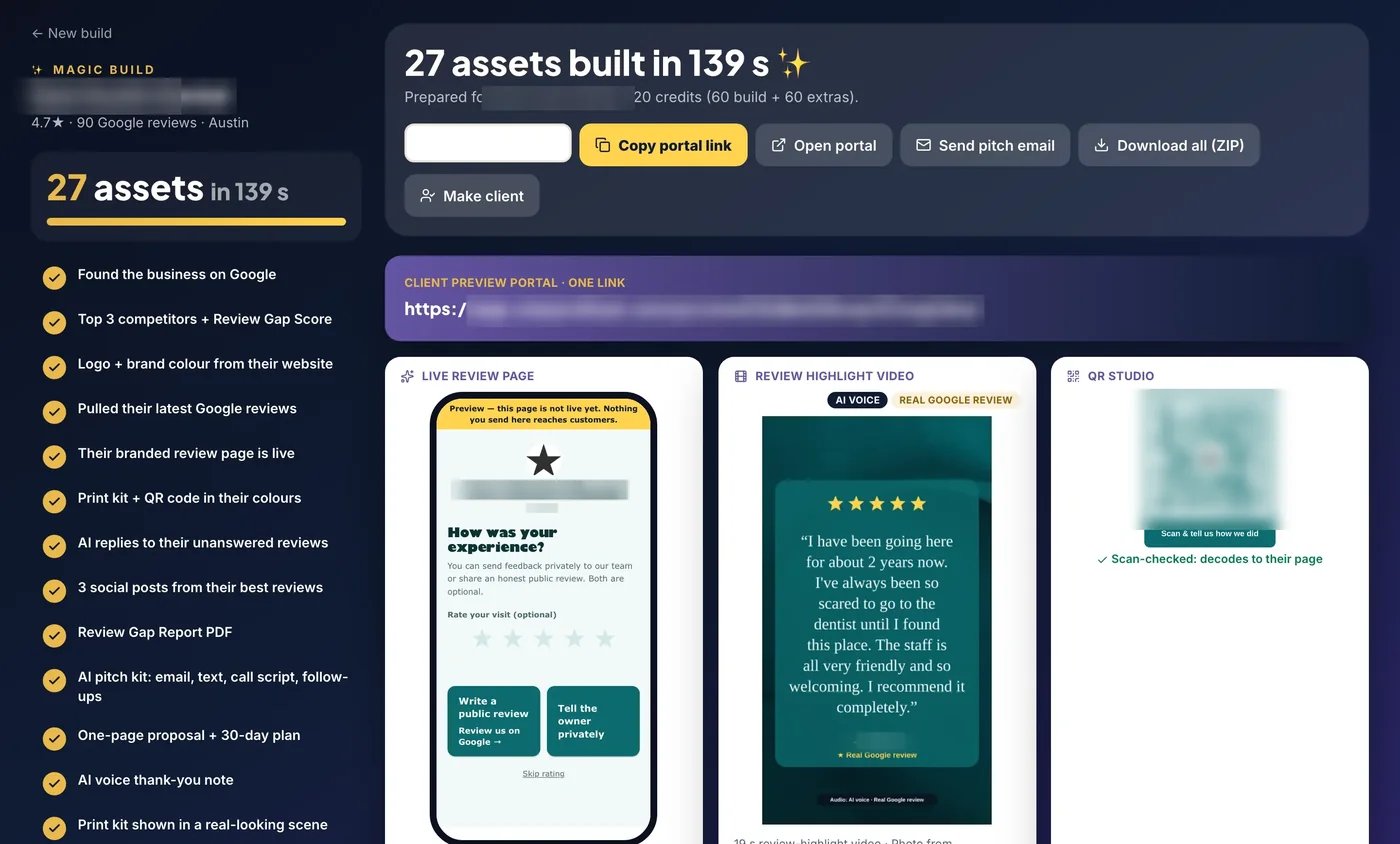
Official materials show Magic Build producing 27 assets from one business name. The illustrated dental-practice run is labeled 139 seconds, with identifying details blurred. That is the seller’s captured example. The time needed to find the correct listing, inspect generated content and obtain approval will vary.
The kit can include a review page, QR code, print materials, a review-gap report, reply drafts, social content, a pitch, a proposal and a client preview. Judge each asset by whether it accurately describes the business and whether someone can use it. Check a printed QR on a real phone, confirm the destination, remove unsupported proposal language and verify the client’s branding.
Our Magic Build breakdown explains the asset-review process. The separate Star Finder guide covers prospect discovery and the limits of treating public listing data as a qualified lead.
The review-request design needs an informed choice
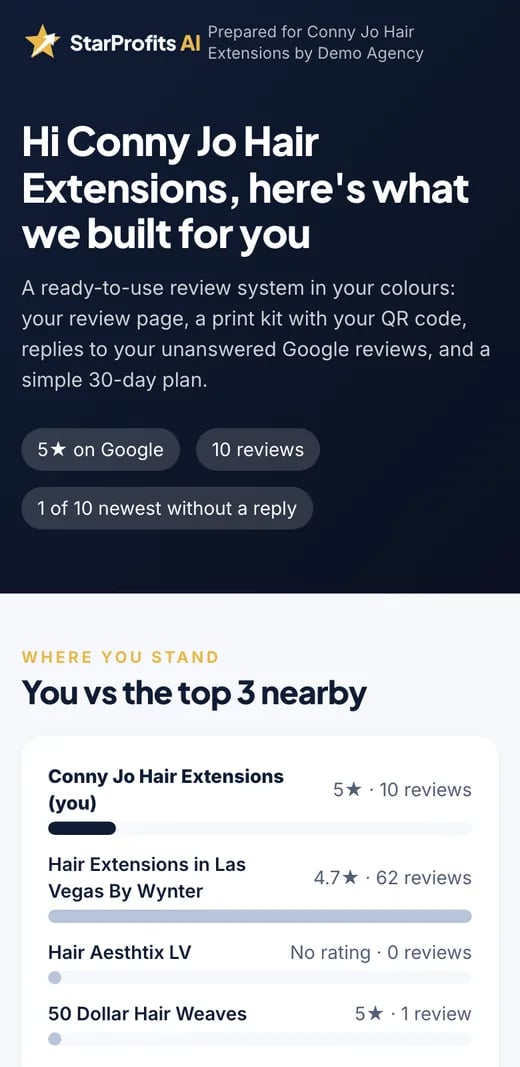
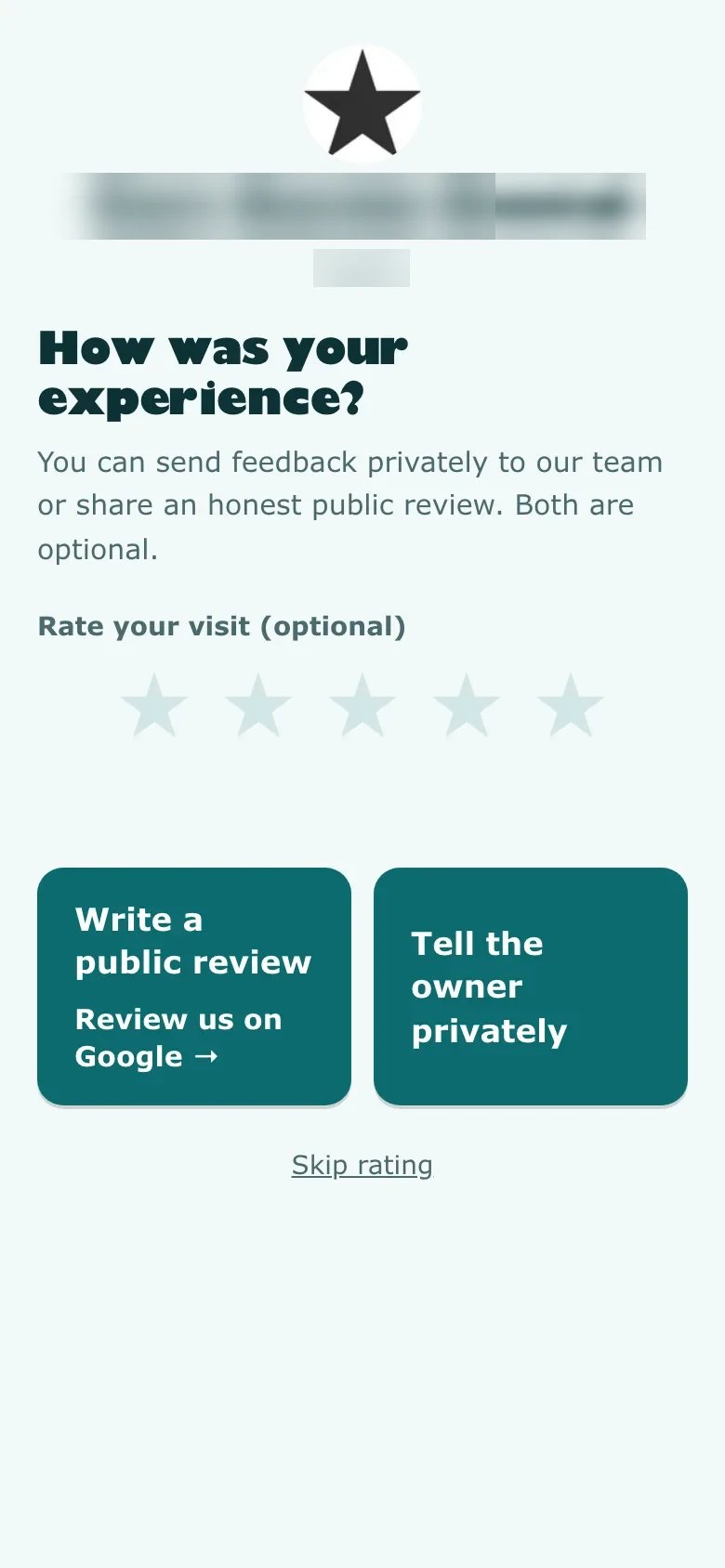
The seller’s rating-adaptive design presents different layouts by score. At 1–3 stars, a private feedback box appears first with a smaller public Google review option on the same screen. At 4–5 stars, the default description includes a short countdown toward Google with an option to stay. The seller also describes turning adaptation off so the public and private choices sit side by side at every score.
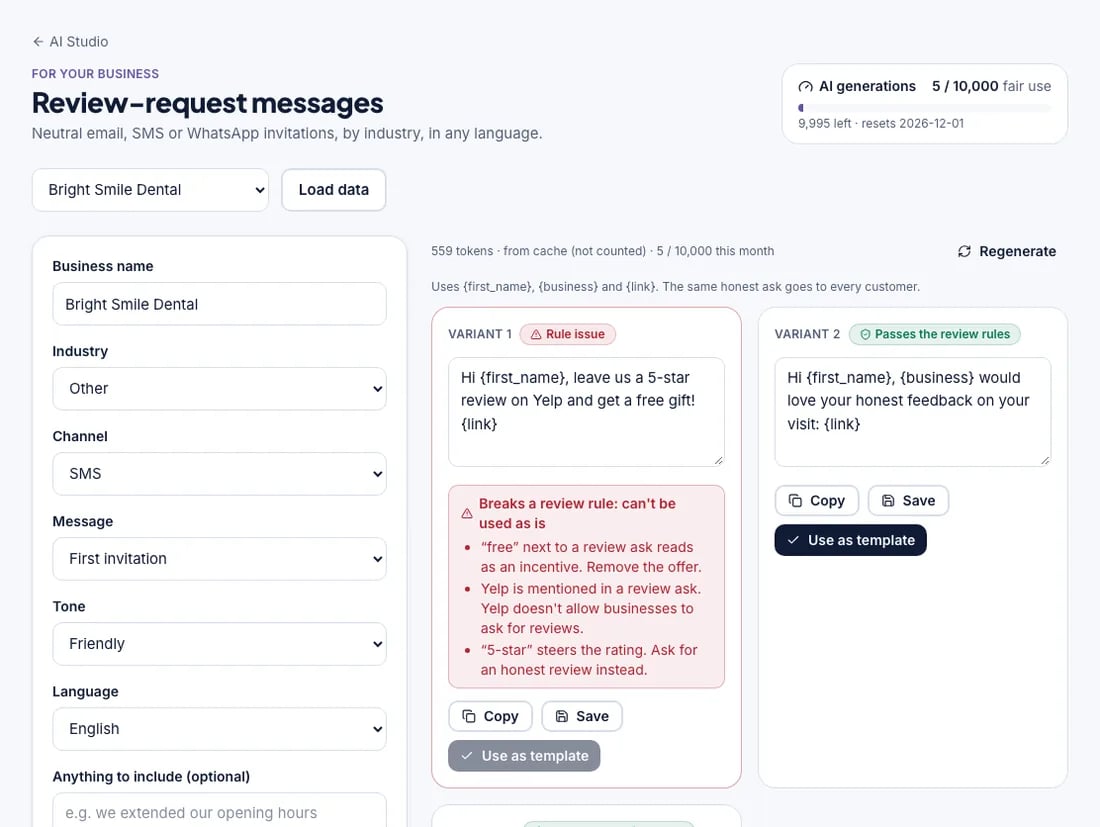
Those details matter. Google’s published policy prohibits discouraging negative reviews and selectively soliciting positive reviews. Leaving a public option visible does not by itself settle whether an entire customer journey follows that policy. An agency should examine the actual page, request wording and audience-selection rules together.
The review-page and Google policy guide explains the behavior and a customer-journey checklist. Avoid rewards for reviews, selective solicitation or claims of Google approval. A workflow can help organize genuine requests while the operator remains responsible for how they are sent.
Replies and recovery still need an owner
The ordinary documented reply flow is explicit. AI drafts a response, one tap copies it and opens the review in Google, and the user pastes and posts it. The seller describes additional Pro reply rules with negative feedback still requiring approval. Verify the exact automation available in your account before promising it to a client.
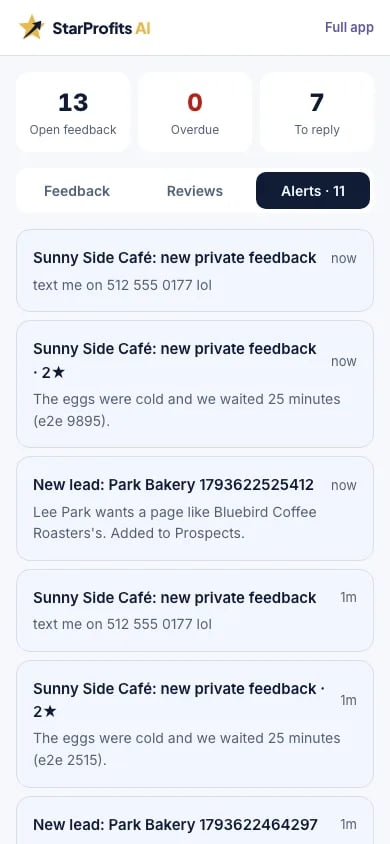
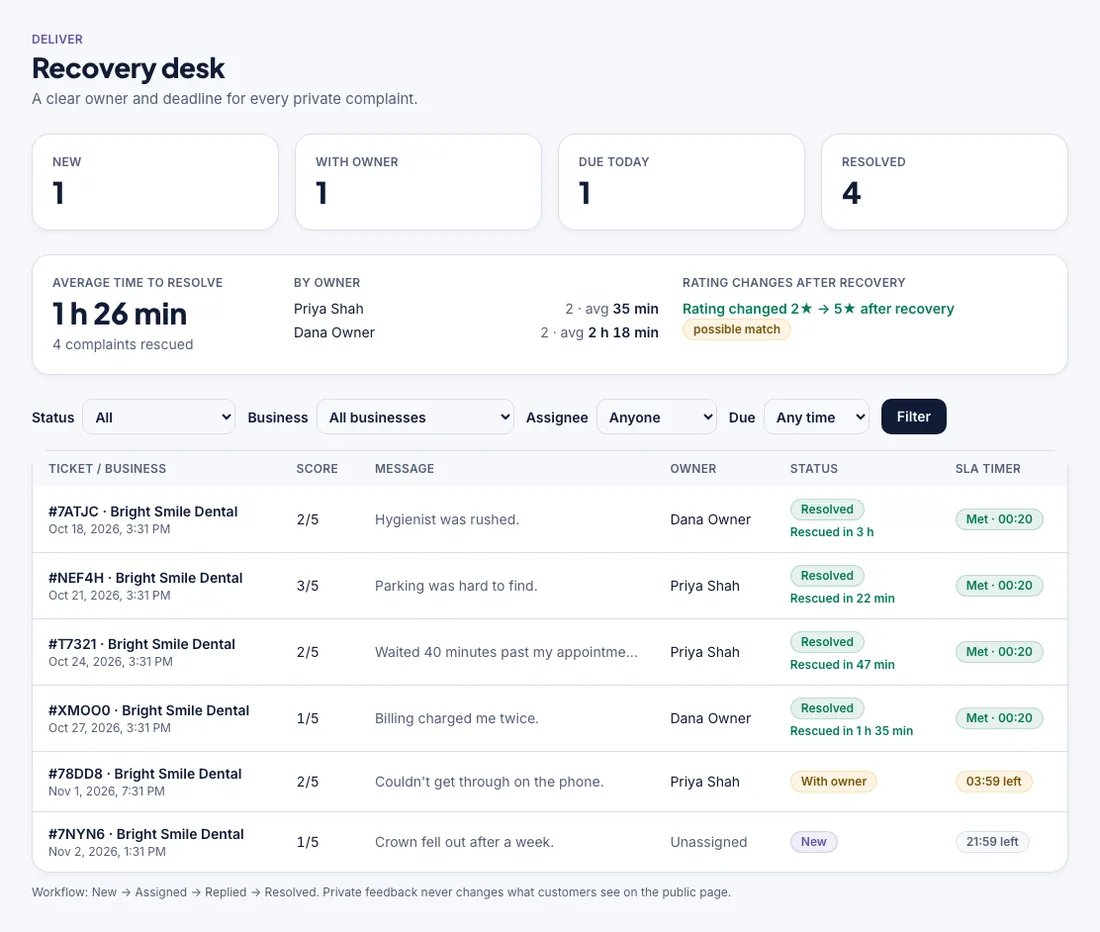
The recovery desk assigns private complaints an owner and a deadline. Owner alerts can help a business notice outstanding feedback. The value depends on someone reading the ticket and resolving the underlying problem. A closed ticket and a changed public review are different outcomes.
Use the AI reply guide for tone and fact-checking, and email and SMS guide for delivery requirements. SMS uses the buyer’s own Twilio account, so assess its charges and customer permissions alongside the software package.
Show authentic feedback and explain activity
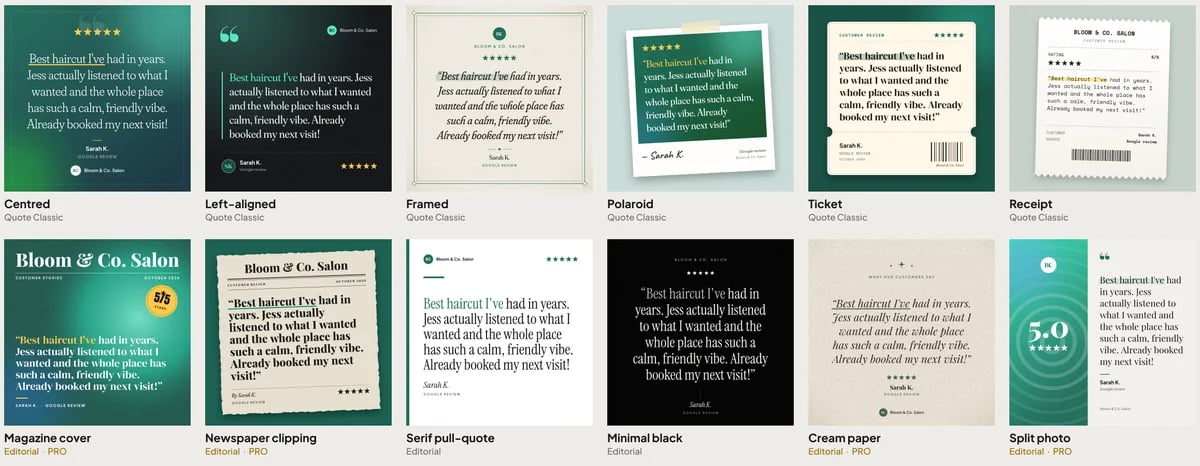
StarProfits AI’s advertised display tools include Review Stories, a Wall of Love, a widget gallery and Social Card Studio. The seller lists 13 widget styles on Basic and 30 on Pro, plus 30 social-card designs across three formats. These are presentation options for real reviews, with no permission to invent a customer quote or imply an endorsement beyond the original feedback.
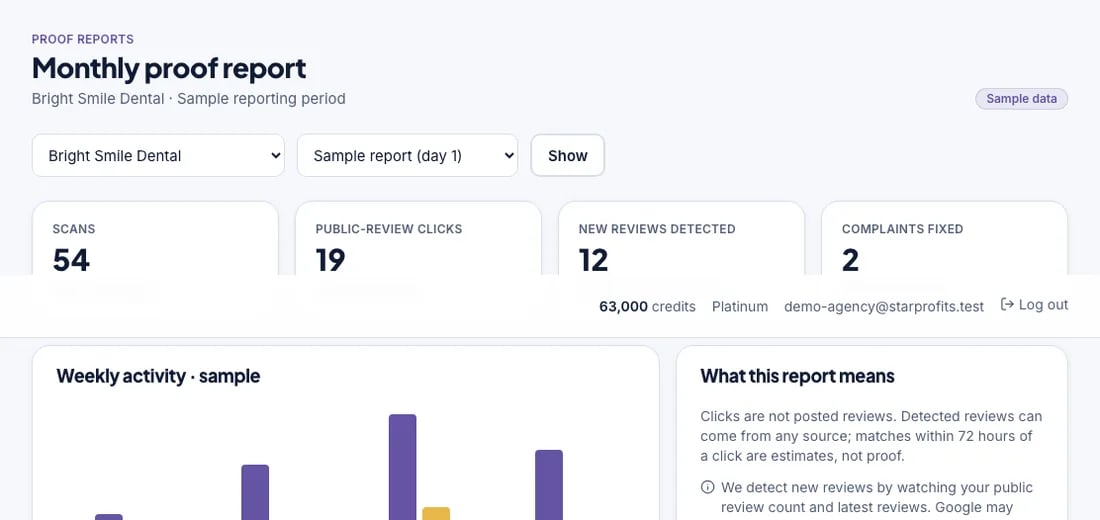
The monthly report can show scans, clicks toward public review sites, newly spotted reviews and fixed complaints. Those measures answer different questions. A scan is an interaction with the request materials. A click is a step toward a review. Neither establishes that a particular request caused a sale or that every new review came from the campaign.
The review-display guide helps choose a format and preserve context. The reporting guide separates activity, review observations and business outcomes before they reach a client report.
Pricing and launch availability
As checked on November 8, the published public launch is scheduled for November 18, 2026 at 11 AM EST. The seller advertises Basic at $37 throughout the launch, Gold at $297 and a Platinum launch coupon offer of $697. The coupon is scheduled to end November 23 at 11:59 PM EST, after which the advertised Platinum price is $797 until the November 25 cart close at 11:59 PM EST.
The seller also lists a two-payment Platinum option of 2 × $397, totaling $794, and a $297-per-month Platinum offer for new customers after launch. These options have different totals and billing structures. Verify the selected order rather than treating every displayed amount as the same deal.
| Option | Published amount | Decision to verify |
|---|---|---|
| Basic | $37 launch | Business allowance and starter credits |
| Pro | $67 | Follow-ups and expanded features |
| Star Finder Pro | $97 | Bulk prospecting and scan allowances |
| Agency / Agency Plus | $147 / $297 | Workspace and branding rights |
| Workshop | $197 | Live schedule and access |
| Reseller Rights | $297 / $497 | 10-account or 100-account terms |
| Gold | $297 | Bundle contents |
| Platinum | $697 coupon / $797 list | Deadline, installment or recurring selection |
Use the full StarProfits AI pricing guide for offer dates, installment arithmetic, launch bonuses and additional operating costs. The live seller order determines actual availability and charges.
Who is likely to find it useful
The product is most relevant to an operator who can connect software activity to a repeatable local-business service. Existing agencies may value shared branding, review-request materials and an understandable report. An owner managing a small number of locations may care more about a working request link and timely replies than prospecting or reseller rights.
Someone who already has a CRM should compare the complete workflow before adding another subscription or upgrade. Check whether their current system handles requests, review displays and reporting, and whether a dedicated tool removes meaningful manual effort. Our alternatives framework compares those categories without relying on untested vendor rankings.
For client delivery, the commercial and agency-license guide separates providing a service from reselling software accounts. Choose rights around an actual delivery plan and a client you can support.
Seller identity, refunds and remaining questions
The official footer identifies Nicely Media LLC and the partner page names Chad Nicely, Karthik Ramani and Maddy. That documents the seller’s stated identity. It does not establish a representative sample of independent customer reviews or validate every performance statement.
The seller’s FAQ states that a buyer can request a full refund through nicelysupport.com within 30 days without having to prove anything. Its standalone privacy, terms and refund links were unresolved placeholders in the reviewed partner pages. Read the refund guide and preserve the actual order terms before relying on that summary.
Other details deserve a direct answer before a sensitive or large deployment. These include data retention, deletion, API limits, precise package allowances, contact permissions and the scope of reseller rights. The privacy and integration checklist makes those questions concrete. Our review methodology explains the evidence behind this site.
StarProfits AI features: what matters in everyday use
| Capability | Practical value to evaluate | Important boundary |
|---|---|---|
| Star Finder | Prepare a business-specific review-gap conversation | A public listing is not a qualified or signed client |
| Magic Build | Prepare connected customer and agency materials | Generated content and destinations still need inspection |
| Review pages and requests | Give customers a repeatable feedback route | Audience selection and page behavior need responsible configuration |
| AI replies and recovery | Prepare responses and assign private issues | Approval and real service follow-through remain human work |
| Widgets and social formats | Present existing authentic feedback clearly | Source accuracy, context and permission still matter |
| Client reports and portal | Explain service activity to a business owner | Recorded interactions do not establish revenue attribution |
The useful comparison is how these parts support a complete service, rather than how many feature names fit in a list. A business needs a correct destination and a routine its team understands. An agency also needs an understandable proposal, agreed responsibilities and a way to report the work.
Our step-by-step workflow guide follows those handoffs. If a feature is central to your purchase, use its dedicated guide to identify the package allowance and the account behavior that needs confirmation.
Three practical buying scenarios
An owner with one location. The core question is whether StarProfits AI makes requests, replies and private feedback easier to maintain. Start with the actual staff routine. If a direct review link and owner-managed replies already work well, the prospecting and reseller features may add little to that particular need. The alternatives guide compares those approaches by task.
A freelancer offering a local service. The business-specific kit can make an offer easier to demonstrate. The freelancer still needs to find appropriate prospects, explain the service, win agreement and support the client. A generated proposal gives the conversation substance, while its price, promises and scope need the freelancer’s judgment. The Star Finder guide explains the gap between finding a listing and qualifying a prospect.
An agency with several clients. Shared branding, client previews and consistent reporting may be more relevant than the speed of one initial build. Check business capacity, access rights, staff approvals and client exit arrangements. The agency-license guide distinguishes commercial service, branded workspaces and account resale. These are illustrative buyer scenarios, not records of tested customer outcomes.
Is StarProfits AI worth considering for your business?
The strongest case is a recurring service where the connected outputs remove coordination you would otherwise perform manually. Building a customer page, QR material, reply drafts and a report in one workflow may be useful when those are already part of your work. Value becomes easier to assess when you can name the task, the person responsible and the recurring effort involved.
The weaker case is buying primarily because an asset count or a fast demonstration suggests the service will sell itself. A 27-asset build does not validate every asset or acquire a client. An attractive report does not establish improved sales. The publisher’s Tried & liked label reflects reported experience, while the supported buying assessment remains tied to the documented workflow and its limits.
Before choosing a package, inspect one complete business journey and compare the entitlement with your real requirements. Read the separate StarProfits AI pricing guide for charges and the pros and cons guide for the balance of benefits and limitations. A larger bundle needs a larger delivery reason than simply including more components.
What to check before you choose an offer
- Confirm the business task. Decide whether you need requests, reply coordination, display materials, agency delivery or account resale.
- Check the customer journey. Inspect the actual public and private routes, score settings and invitation wording.
- Verify the selected package. Match active-business capacity, themes, follow-ups and rights to the work you intend to deliver.
- Calculate operating costs. Include separate messaging charges, any external plans, setup and ongoing staff time.
- Clarify the data terms. Obtain current privacy, retention, deletion and integration documentation where the reviewed overview leaves gaps.
- Preserve the order terms. Keep the selected payment structure, inclusions and refund statement.
This checklist is the practical conclusion of our review. It connects the appealing kit-generation features to the conditions needed for a sustainable service. The setup guide helps with the first business, the reporting guide helps define the recurring deliverable and the refund article explains the published guarantee. The seller’s order page confirms current availability and the exact offer you select.
Common questions
What is StarProfits AI?
The seller presents it as review-request and reputation-management software for local businesses, freelancers and agencies. It creates review pages, QR assets, reply drafts, prospect materials and client reporting.
When is the public launch?
The seller schedules November 18, 2026 at 11 AM EST. An early-access webinar is scheduled for November 17 at 8 PM EST. Availability must be confirmed on the seller’s current page.
Does StarProfits AI post replies directly to Google?
The documented standard flow drafts a reply, copies it and opens the Google review. The user pastes and posts it. Pro automation is described separately and should be verified before relying on it.
Does the Tried & liked label prove a particular result?
It records the publisher’s qualitative experience. It provides no measured claim about review growth, customer acquisition, revenue, Google rankings or coverage of every upgrade.
Are there verified customer reviews?
Our reviewed source set does not establish a representative body of independent StarProfits AI customer feedback. Seller screenshots use demo, sample or blurred business data and do not establish typical buyer results.
Who is StarProfits AI most relevant to?
The connected kit is most relevant to an operator who needs business-specific review materials, request coordination and understandable client reporting. Existing local agencies may have more recurring tasks to consolidate than a single owner who already manages a simple review link effectively. Package rights and staff responsibilities should match the actual service.
What is the difference between Basic, Gold and Platinum?
Basic is the advertised $37 launch entry with stated business and feature allowances. Gold is a $297 bundle route. Platinum is advertised at a $697 launch coupon amount, with broader upgrade, portal, reseller, workshop and setup descriptions. Check the full inclusion list and billing selection; a bundle name alone does not establish every entitlement.
Can this review establish typical earnings or review growth?
No representative measured earnings, client-acquisition rate or review-growth result has been supplied for this publication. Tried & liked records the publisher’s qualitative experience. The feature analysis is based on dated official materials, and illustrative scenarios explain operating decisions rather than report customer outcomes.
Sources and verification
Product facts and launch offers checked on November 8, 2026. Seller demonstrations and published terms support the factual descriptions. Practical checklists are our editorial analysis.