
What the publisher liked
The publisher reports Tried & liked experience with StarProfits AI. That qualitative verdict sits alongside a documentary review of the seller’s feature descriptions. It does not establish a measured setup time, revenue result or coverage of every paid upgrade.
The strongest reason to examine the software is the connected handoff from finding a business to preparing its review kit and explaining the work to its owner. Read the full StarProfits AI review for the overall assessment, then use the trade-offs below to check your own fit.
Supported strengths
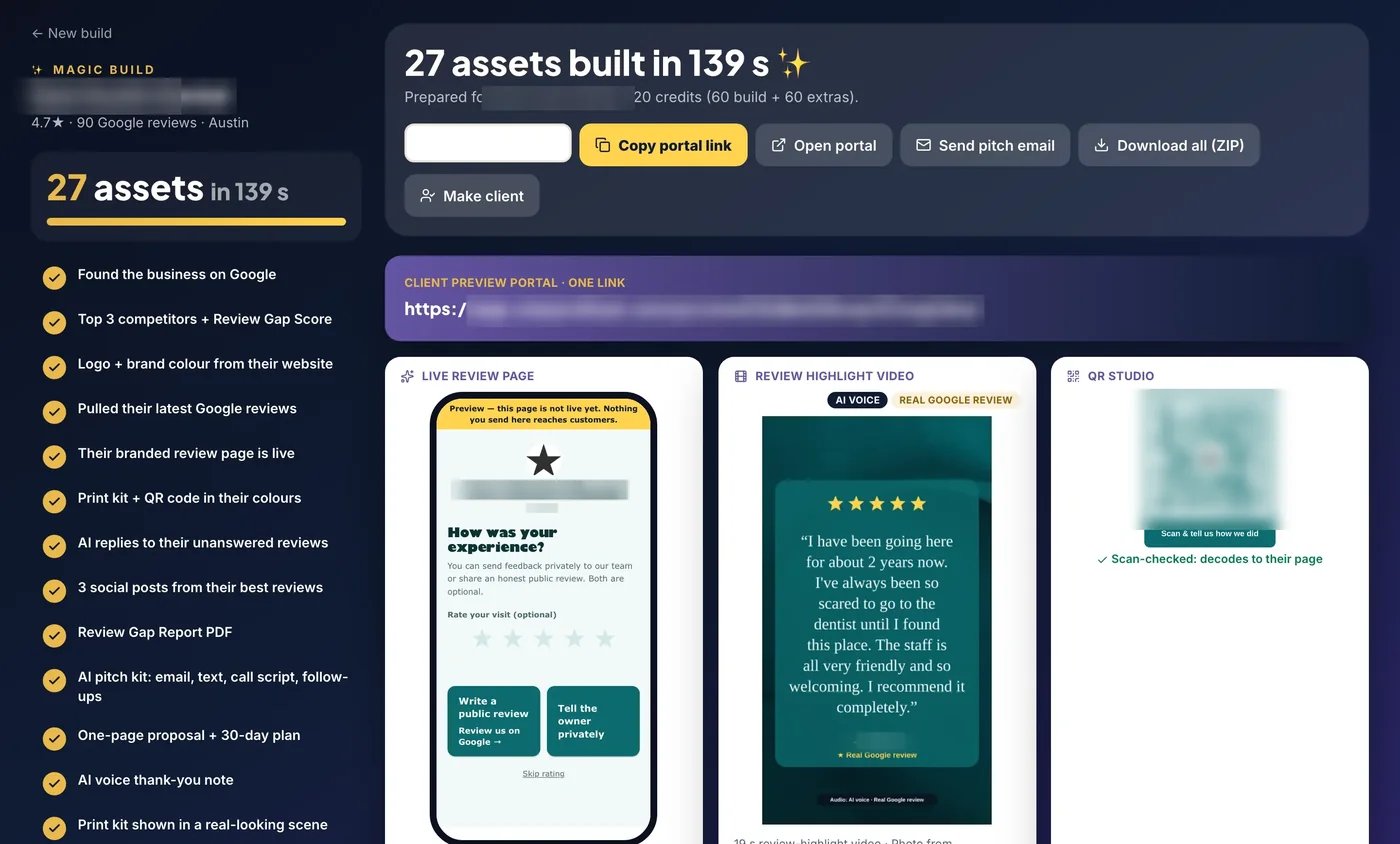
- A connected starting point. Magic Build is described as creating a review page, QR material, a report, reply drafts and prospect-facing assets from a business name.
- Several ways to deliver. Print material, email requests, review stories and client reporting support different stages of a service.
- Human approval remains visible. The described reply flow gives the operator a draft to inspect before posting.
- Branding is part of the offer. Agency-facing material can present the subscriber’s brand, with broader portal and account rights tied to package choices.
- Feedback can lead to action. A recovery desk gives private issues an owner and deadline, while reports summarize activity.
Those features address repetitive production and administration. The Magic Build breakdown examines what needs checking after generation.
Material limitations
The rating-adaptive page needs close attention. The seller describes private feedback opening first after a low score, with a smaller public-review option below. That difference matters when evaluating the customer experience. The review-page guide explains the behavior and the setting that presents both choices side by side at every score.
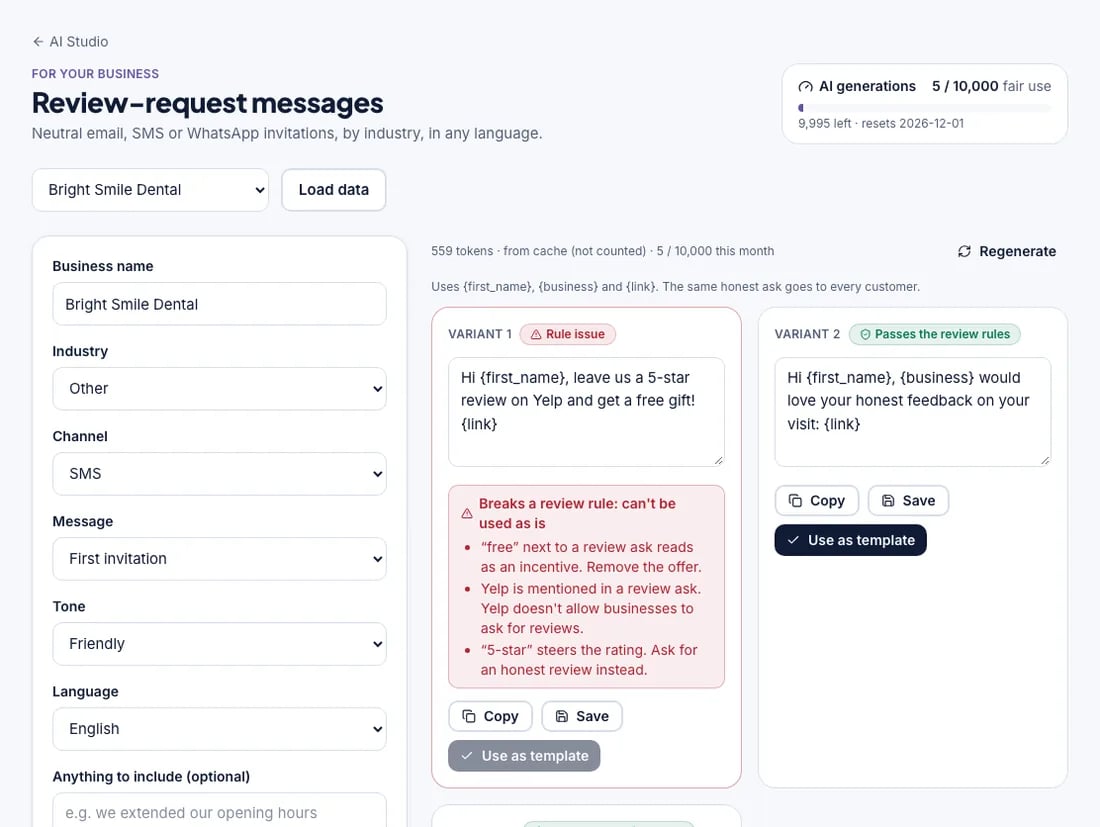
SMS requires your own Twilio account. Reply drafts need checking for tone, accuracy and privacy. Automatic follow-ups, expanded themes, widget choices and higher allowances may sit in paid upgrades. The seller’s speed demonstrations use selected businesses, so the stated 139-second build and five-minute start should be treated as examples rather than your expected completion time.
Who is likely to use the workflow
A freelancer already speaking with local owners can use the product’s preview assets to make a service concrete. A small agency with a named person reviewing replies and following up complaints has a clearer delivery model than a buyer relying on automatic client acquisition.
An owner managing a single location may value a simpler review-request process but should compare it with their existing tools and the direct options described in our alternatives guide. The important question is how much recurring coordination you need across businesses, staff and channels.
Where the connected workflow can save coordination
The most persuasive strength is the relationship between the outputs. A QR code, review page, client preview and report all belong to the same business workflow. When those materials are maintained separately, an agency has to keep destinations, branding and explanations aligned by hand. StarProfits AI’s advertised kit gives the operator a shared starting point for that work.
Consider a business changing its public contact details. The useful question is how easily the operator can inspect every affected touchpoint and confirm the customer still reaches the correct place. Generating more assets is valuable only when maintaining them remains manageable. Ask how edits propagate and which outputs need to be regenerated; the public overview does not fully document that behavior.
This makes the toolkit most interesting for someone already delivering a review service and encountering repeated administrative steps. A buyer who only needs a direct review destination may have less to consolidate. The alternatives framework compares that simpler starting point with a dedicated tool, and the Magic Build guide examines the checks behind a usable kit.
The trade-off between more output and more responsibility
A larger kit creates more opportunities to show useful work, but also more material to approve. An attractive proposal can still contain an unsuitable service scope. A review card can still lose context. A ready QR image can still be printed too small. These are reasons to build a repeatable quality check around generation rather than equating asset count with completion.
The product’s approval steps are helpful when a real person owns them. They also mean the service does not run unattended. Reply drafts require judgment, customer requests need an appropriate recipient list and private complaints require a response. The reply approval guide explains what remains between drafting and a public Google response.
Plan dependencies add a second trade-off. A low entry price is useful for evaluating the core process, while broader automation or agency rights may require a different purchase. Compare the exact task you need with the current entitlement table. Our assessment favors checking one complete business workflow over buying the largest package simply because it displays the longest feature list.
A fit check for three kinds of buyer
| Buyer | Potential value | Main question |
|---|---|---|
| Single-location owner | A repeatable request and feedback routine | Will staff maintain it more reliably than the existing process? |
| Local-service freelancer | A concrete kit to demonstrate and deliver | Can you sell, configure and support the service yourself? |
| Agency with several clients | Shared branding, approval and reporting work | Do business allowances and access rights match your roster? |
Use this as a conversation with the person who will actually operate the account. A manager may want better visibility, while the staff member sending requests may need a simpler daily routine. Both needs should appear in the evaluation. If nobody owns complaint follow-up, a more polished report will not solve the underlying service gap.
The publisher’s Tried & liked verdict remains a qualitative experience label. This fit assessment is our analysis of the documented workflow, not evidence of a particular retention, review-growth or revenue result. The separate pricing article provides the amounts once the required workflow is clear.
A practical buying test
Write down one business you are authorized to work with and the first month of tasks you would deliver. Include review-page setup, a neutral invitation, reply approval, complaint follow-up and a report explaining activity. Then check whether the chosen package covers that workload.
Use the separate pricing guide to compare charges and allowances. Request written clarification about any unclear cap, integration or right before purchase. An organized tool is useful only when the operator has permissions, customer context and time to provide the service.
Common questions
Does Tried & liked mean every upgrade was tested?
It is qualitative publisher-reported experience. It does not establish testing duration or coverage of every package, integration or upgrade.
Can StarProfits AI find paying clients automatically?
The seller describes prospecting and pitch assets. An owner still needs to agree to the service, and the buyer must handle outreach and delivery.
What should I verify first?
Check the actual package allowances, the customer-facing review-page behavior, the reply approval process and any external messaging costs.
What is the strongest practical benefit of StarProfits AI?
The documented strength is the connection between business research, a branded review kit, customer-feedback work and client reporting. That can be useful when an operator already needs to coordinate those tasks. Its value depends on correct setup, suitable package allowances and someone maintaining the workflow, rather than the number of generated assets alone.
What is the most important limitation for a new agency?
The software prepares materials but does not establish paying clients or remove sales and support work. The agency still needs to obtain agreement, configure the correct customer journey, approve wording and follow up issues. A service plan and named responsibilities are therefore more useful buying criteria than an assumed automatic-client-acquisition outcome.
Sources and verification
Product facts and launch offers checked on November 8, 2026. Seller demonstrations and published terms support the factual descriptions. Practical checklists are our editorial analysis.